Half-Hearted Design Pays Almost Nothing: What McKinsey's 300-Company Study Actually Says
McKinsey's 2018 study tracked 300 public companies for five years. Top-quartile design performers grew revenue 32 percentage points faster than industry peers, but the bigger finding is that the other three quartiles performed almost the same, so design done halfway delivers close to nothing. Top performers measured design like revenue, shared it across teams, kept testing with users, and connected physical, digital and service experiences.

In most companies I have worked with, designers get called in after the important decisions are made. The brief is already written, or half written, and the job is to execute it.
After years of seeing the same pattern, I started asking a simple question. Does it actually matter to the business if design is taken more seriously? It turns out McKinsey studied exactly this, at scale. And the most important finding is not the number everyone quotes.
What did McKinsey actually study?
In 2018, McKinsey published The Business Value of Design. They tracked 300 publicly listed companies across several countries over five years, in three industries: consumer goods, medical technology and retail banking.
They collected more than two million pieces of financial data and recorded more than 100,000 design actions. From that, they built a score called the McKinsey Design Index (MDI) to measure how seriously each company practiced design, then compared those scores with business performance.
”Design” here does not mean UI
Before going further, this part matters. In this study, design is not just the interface, and it is not just visuals. It is a company’s whole design capability: physical products, digital products and services.
Think about how a hospital handles its queue. From the moment you arrive, to waiting, to being called, to going home, every step of that flow was designed, well or badly. That counts too.
So if you hear someone say “UI/UX increases revenue by 32%,” that is a misquote.
The study measures design as an organizational capability across physical, digital and service experiences. Quoting it as proof that “better UI grows revenue” misrepresents what was measured.
The number everyone quotes
Companies in the top quartile of the index grew revenue 32 percentage points faster than their industry peers over the five-year period. Their total returns to shareholders were 56 percentage points higher.
This is the number that ends up in pitch decks. But the same chart contains a finding that rarely gets mentioned.
Does a little more design pay a little more?
McKinsey split the 300 companies into four groups. Look at the bottom three: their results were almost the same. The second quartile was not much better than the third, and the third was not much better than the bottom.
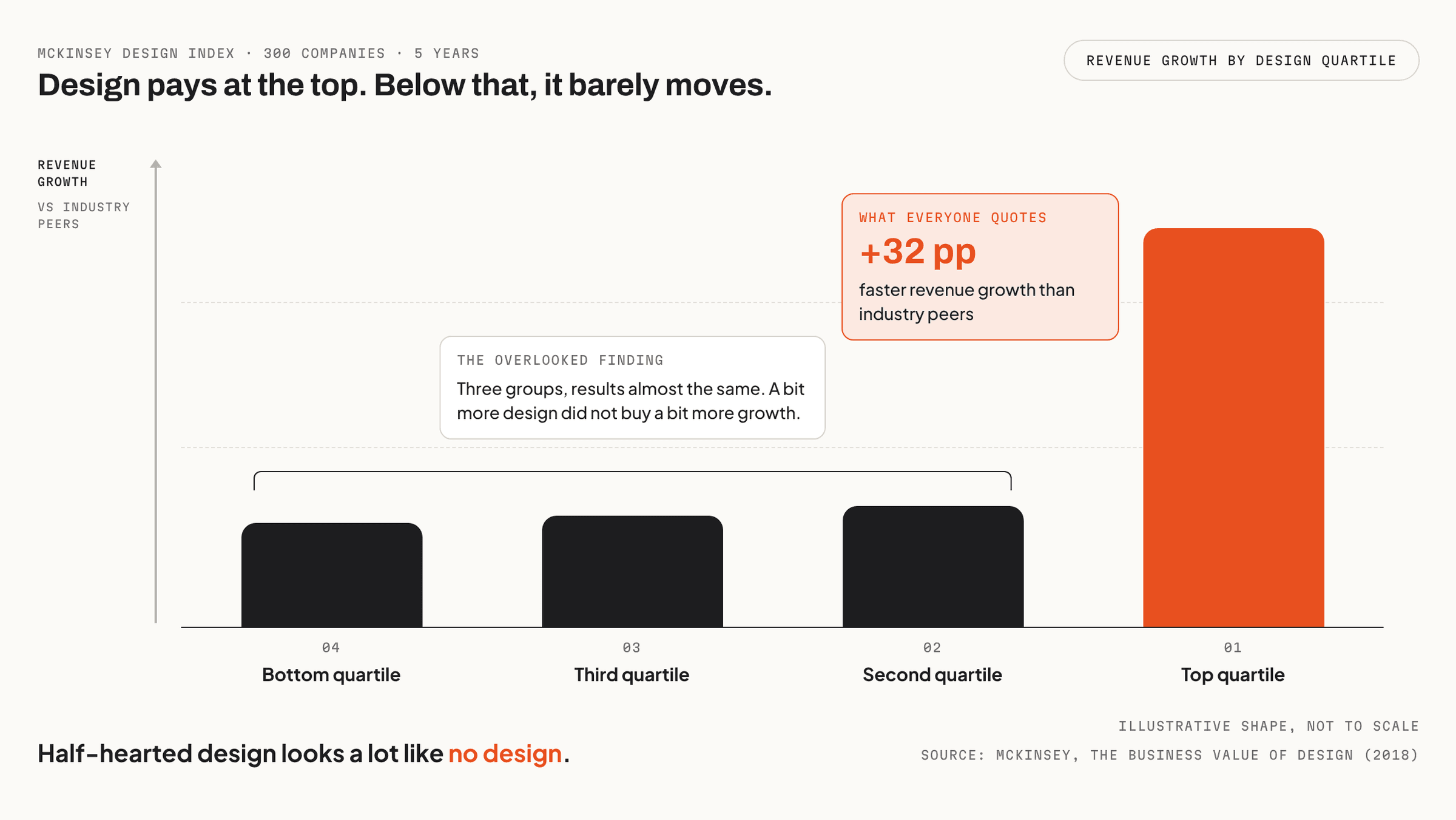
That means the relationship between design and business results is not a gentle slope. A little more design effort does not produce a little more return. The payoff shows up when design is done properly. Done halfway, the result looks almost the same as not doing it at all.
This is the part I find most useful, because it changes the question. The question is not “should we invest in design?” It is “are we willing to do it properly, or are we paying for design that cannot move the needle?”
What did the top quartile do differently?
McKinsey identified four themes among the top performers.
1. They measured design as rigorously as revenue and cost. Design performance had targets and was tracked, not judged by “it looks good.” When design is never measured, it is rarely invited into decisions.
2. Design was everyone’s responsibility, not one team’s. Business, engineering and operations shared ownership of the user experience instead of handing it to designers at the end.
3. They kept listening, testing and iterating with users. Not one round of research at the start, but continuous testing that reduced risk before big money was committed.
4. Physical, digital and service experiences were connected. They broke down the walls between these areas. In the hospital example, the booking app, the registration desk and the waiting room are one experience, not three separate projects.
Why “just execute” lands you in the flat middle
This part is my interpretation, not a finding from the study.
Go back to the pattern I described at the start: designers are called in only to execute decisions that were already made. In that setup, design is not measured, not cross-functional and not tested early. Almost none of the top-quartile habits can happen.
A company working that way is very likely sitting in one of the three groups that performed almost the same. It is paying for design, and getting results that look a lot like not paying for it.
Where should a team start?
The good news is that McKinsey’s advice is practical. Do not launch a company-wide “design culture” program, because that is exactly how design becomes half-hearted. Pick one important product or service, do the design work properly from start to finish, measure the result, and use it as proof to expand.
One project done well tells a team more than a culture deck ever will.
Two honest caveats
First, this is correlation, not causation. Companies that are already performing well may simply be better positioned to invest in design.
Second, when the report was published, McKinsey was building its own design business, having earlier acquired the design firm LUNAR. That does not make the data wrong, but it is worth reading with that context in mind.
Even with both caveats, the pattern of three groups performing almost the same is worth taking seriously.
The question worth asking your team
In your company, is design involved from the beginning, or only after the decisions are made?
If the honest answer is the second one, the study suggests the fix is not more design output. It is changing when design enters the conversation, starting with one product that matters.
That is the work I care about most: helping teams decide what to build, and why, before anyone opens a design tool. If that is a conversation your team needs, tell me what you’re building.
Sources
- McKinsey, Why design means business
- Dexigner, summary of McKinsey’s The Business Value of Design
- Metropolis, a critique of McKinsey’s 2018 design value study