Design Thinking, Double Diamond, or Design Sprint? A Practical Guide to Choosing the Right Method
Most teams can define Design Thinking, Double Diamond, and Design Sprint but struggle to pick the right one for a given project. This piece reframes them as answers to different constraints rather than a hierarchy, with Design Sprint as a time-boxed tactic rather than a replacement for the other two. The result is a decision guide built around the question that actually matters: when to reach for each one.
The question nobody asks out loud
Ask a room full of designers to define Design Thinking, Double Diamond, and Design Sprint, and most hands go up. Ask them which one their current project actually needs, and the room goes quiet.
That gap is more common than portfolios admit. Knowing the five stages of Design Thinking doesn’t tell you when a five-day Design Sprint is the smarter call, or when reaching for either one is overkill for a problem that just needed a clear brief and a working prototype.
This isn’t a glossary post. It’s a decision guide, built around the question that actually matters: not “what is it,” but “when do I reach for it.”
First, the piece that’s usually explained wrong
Most explanations stack these methods into a hierarchy, as if Design Thinking sits above Double Diamond, which sits above Design Sprint. That’s a tidy diagram and a misleading one.
Here’s a more accurate way to hold them:
User-Centered Design (UCD) is a principle, not a process. It’s the standing rule that decisions get made from user needs and evidence, not assumption or preference. Every method below only works if this principle is actually being followed, not just referenced in a slide.
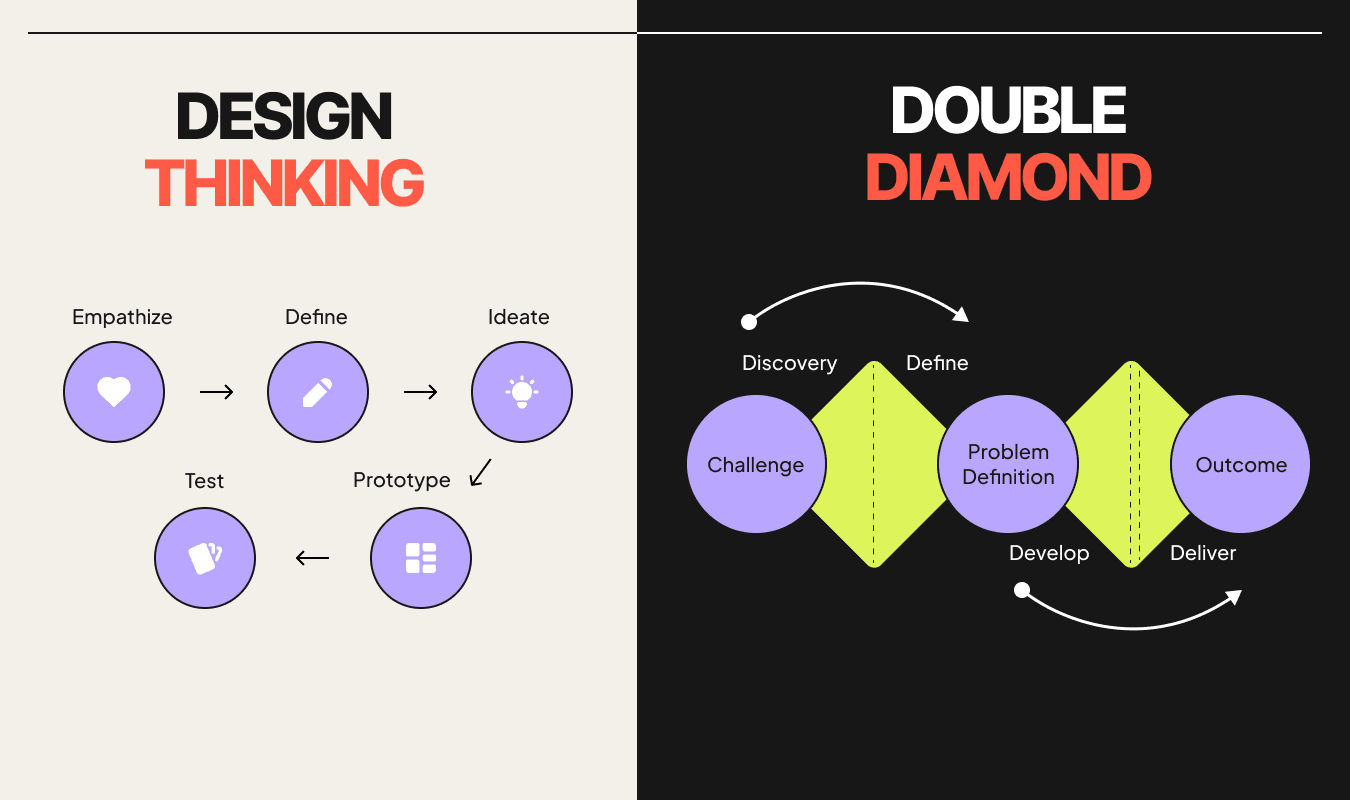
Design Thinking and Double Diamond sit at the same level: both are process models for human-centered problem-solving, and both answer the same underlying question. They’re not one derived from the other. Design Thinking (Empathize, Define, Ideate, Prototype, Test) leads with empathy as an explicit stage and tends to be framed as iterative and overlapping. Double Diamond (Discover, Define, Develop, Deliver) leads with the shape of the thinking itself: diverge, converge, diverge, converge, with a hard line between understanding the problem and building the solution. In practice, most teams blend elements of both without labeling it either way, and that’s fine.
Design Sprint sits a level below, as a specific tactic. It’s a compressed, time-boxed technique (typically five days) for validating a direction fast, before committing serious budget or engineering time. It’s not a replacement for Design Thinking or Double Diamond. It’s a way to run a fast lap through similar thinking when the situation demands speed over depth.
The actual decision guide
Instead of picking a method first, start with the constraint that’s actually driving the project:
Tight timeline, need to validate before committing budget. Reach for a Design Sprint. It exists precisely for this: get a testable answer in days, not months, before engineering or marketing spend is locked in.
New problem space, requirements still loose, real exploration needed. Reach for Double Diamond. The explicit separation between “are we solving the right problem” and “are we solving it right” protects against the most expensive mistake in design: building a polished solution to the wrong problem.
Team already has a working process but decisions keep drifting from user needs. This isn’t a process problem, it’s a UCD problem. Apply it as a lens on the process you already have, not as a new process to bolt on.
Ongoing product work, iterative by nature, no hard external deadline forcing speed. Design Thinking’s overlapping, non-linear stages fit here more naturally than Double Diamond’s cleaner diverge-converge structure.
What it costs to pick the wrong one
This is where method choice stops being academic and starts showing up in outcomes.
Running a Design Sprint on a problem that actually needs deep research produces a confident-looking answer built on shallow evidence. The team moves fast and ships the wrong thing fast.
Running a full Double Diamond cycle on a decision that needed to happen this week burns the one resource a fast-moving team can’t get back: momentum. By the time “Deliver” arrives, the market question may have already changed.
Treating Design Thinking or Double Diamond as a checklist to complete, rather than a lens to think through, produces the worst outcome of all: a process that looks rigorous in a case study and never actually centers the user.

Where I’ve seen this go wrong
Most of the time, the honest version of this story isn’t “I picked the wrong method.” It’s that no method got picked at all. A PRD lands on the desk, already written, already detailed, and the job becomes executing it as-is. No Discover phase to re-check the assumptions inside it, no fast Sprint to pressure-test the riskiest part before building. The document itself quietly becomes the process.
That worked fine until a feature built exactly to spec went live, and users simply didn’t need it. It wasn’t broken, it wasn’t confusing, it just wasn’t something anyone had asked for. A nice-to-have, built at full-have effort, landing on people who never asked for it. The PRD had looked complete on paper. What it hadn’t done was pass through anything resembling validation before the build started, and the fallout from that gap wasn’t small.
The lesson wasn’t “next time use Double Diamond” or “next time run a Sprint.” It was simpler and less comfortable than that: a document that reads as complete isn’t the same as a problem that’s been validated, and skipping that check doesn’t save time, it just moves the cost of finding out to after launch, where it’s more expensive to fix.

The short version
These four aren’t competing options to choose between. UCD is the principle that never turns off. Design Thinking and Double Diamond are two maps to the same destination, pick whichever matches how your team already thinks. Design Sprint is the tool you reach for when speed matters more than depth, for one specific decision, not for how you run the whole project.
The method was never the point. It’s just the current best guess at how to protect the user’s needs under whatever constraint you’re actually working against.